
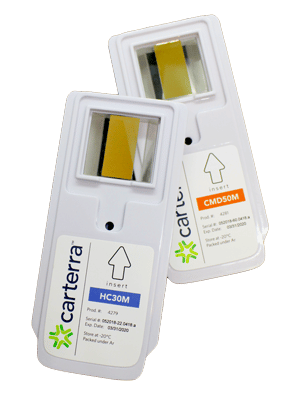
Available Biosensor Chip Chemistries
Carterra Sensor Chips
Selection of the appropriate sensor chip surface is essential for robust data quality when designing a high-throughput SPR assay. Carterra offers a broad range of chip surfaces to support the diverse applications available on the LSA®, LSAXT, Carterra Ultra, and Carterra Vega instruments. Described here are the standard chip offerings. Custom surfaces may be available upon request. Always consult with a Carterra Applications Scientist when selecting sensor chips.
| Linear polycarboxylate | ||
| Name | Description | Application |
|---|---|---|
| HC30M #4279 |
Polycarboxylate hydrogel, medium charge density, 30nm coating thickness | Moderate ligand capacity for general use |
| HC200M #4287 |
Polycarboxylate hydrogel, medium charge density, 200nm coating thickness | Higher ligand capacity for general use |
|
|
||
| Carboxymethylated dextran | ||
| Name | Description | Application |
| CMDP #4282 |
2D planar carboxymethyldextran surface, <5nm coating thickness | Lower ligand capacity for high resolution analysis |
| CMD50M #4281 |
Carboxymethyldextran hydrogel, medium charge density, 50nm coating thickness | Moderate ligand capacity for general use |
| CMD200M #4280 |
Carboxymethyldextran hydrogel, medium charge density, 200nm coating thickness | Higher ligand capacity for increased levels of immobilization |
| CMD500M #4296 |
Carboxymethyldextran hydrogel, medium charge density, 500nm coating thickness | Higher ligand capacity for maximum levels of immobilization |
|
|
||
| NiNTA | ||
| Name | Description | Application |
| NiCMDP #4298 |
 Planar NTA derivatized carboxymethyldextran, < 5nm coating thicknesss Planar NTA derivatized carboxymethyldextran, < 5nm coating thicknesss |
Very low capacity capture of His-tagged molecule |
| NiHC200M #4299 |
Poly – NTA derivatized linear polycarboxylate hydrogel, medium charge density, 200nm coating thickness | High capacity for His-tagged ligand captures |
|
|
||
| Streptavidin | ||
| Name | Description | Application |
| SAP #4295 |
Streptavidin immobilized on 2D planar carboxymethyl dextran surface, <5nm coating thickness | Very low capacity for arraying of biotinylated ligands |
| SAHC30M #4294 |
Streptavidin, immobilized in polycarboxylate hydrogel, medium charge density, 30nm coating thickness |
Lower capacity for biotinylated ligand kinetic lawns |
| SAD200M #4283 |
Streptavidin, immobilized in a carboxymethyldextran hydrogel, medium charge density, 200nm coating thickness |
High capacity for biotinylated ligand captures |
| RSA200M Kit #4365 |
Oligonucleotide derivatized carboxymethyldextran for reversible immobilization of biotinylated ligands, 200nm coating thickness. RSA reagent included. |
Medium capacity reversible capture of biotinylated molecules |
|
|
||
| Protein A | ||
| Name | Description | Application |
| PAHC200M #4291 |
Protein A derivatized linear polycarboxylate hydrogel, medium charge density, 200nm coating thickness |
High capacity for quantitation of human IgG |
|
|
||
| Protein A/G | ||
| Name | Description | Application |
| PAGP #4277 |
Planar protein A/G derivatized carboxymethyldextran, < 5nm coating thickness |
Very low capacity capture of Fc-containing molecules |
| PAGHC30M #4292 |
Protein A/G derivatized linear polycarboxylate hydrogel, medium charge density, 30nm coating thickness |
Moderate capacity for kinetics of multi-species IgG |
| PAGHC200M #4293 |
Protein A/G derivatized linear polycarboxylate hydrogel, medium charge density, 200nm coating thickness | High capacity for quantitation of multi-species IgG |
Notes
While CMD is a well described chemistry for use in biosensors, the linear polycarboxylate chemistry of HC chips provides an alternate surface chemistry to that of CMD in instances of non-specific binding or when differential diffusion characteristics are warranted.
CMD and HC sensor chips can be used to build custom capture surfaces such as anti-mouse or Protein A/G via amine coupling of capture molecules.
When stored at -20 °C CMD and HC surfaces are good for 4 years after purchase, while protein derivatized coatings such as SAD should be used within 2 years.