
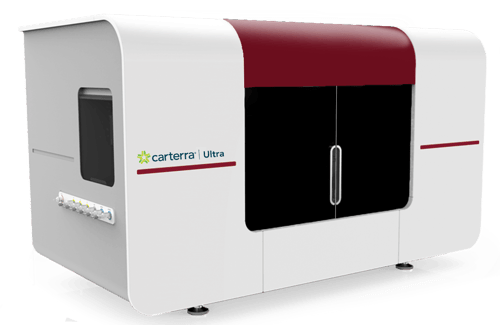
We are proud to introduce Carterra Ultra™. Ultra ushers in a new frontier in fragment and small molecule drug discovery and is the most sensitive biosensor from Carterra yet.

Kinetics and Epitope 2.0
- New software versions have been released! Please update your software by logging into the Carterra web store and downloading the software. Release notes are also available highlighting new features and bug fixes.
- Click this link to download the updated software and corresponding release notes. https://carterra-bio.com/resource-category/software/
Navigator 2.1 for LSA
- We have released a new version of Navigator for Carterra instruments! This version includes various feature requests and bug fixes. Our service team will upgrade your instrument’s Navigator version during the next service visit if it has not already been performed. If it has been performed, then what? Please see our release notes for details regarding the interface improvements.
Updated LSAXT Maintenance and Best Practices Guide
- Please download our updated LSA and LSAXT Maintenance and Best Practices Guide and display this document near the instrument.
https://carterra-bio.com/wp-content/uploads/2025/11/LSA-XT-MBP-Guide-Rev25C.pdf

We now offer another tier of service plan: Summit Plus! This includes 2 Preventive Maintenance visits a year. For more information, reach out to orders@carterra-bio.com.

Reagents
- EDC – prepare at 50-75 mM Final to avoid preconcentration issues due to possible diamine contaminates. HC style chips are more susceptible to electrostatic collapse of the linear polycarboxylate structure introduced by EDC contaminates than CMD style chips.
Navigator 2.1
- We have had multiple instances of a software glitch in which Navigator’s thermals will show an extreme temperature of -273 C. If this occurs, follow the steps outlined below to resolve.
- Open “Task Manager” on the computer.
- Click “Services” located on the right-hand side of the screen.
- Scroll down to the Navigator service, right click, and press restart.
- If you observe a slower than expected performance of the Navigator interface, this can be resolved via archiving the Documents/Carterra/Experiment Data folder. Please ensure all experiment files are properly saved and then delete the contents of that folder to restore normal operating speed.
Navigator 2.5
- After power cycling the Ultra PC or Ultra instrument, Navigator must be opened and closed twice to avoid data loss due to a known camera connection error.
If you observe a slower than expected performance of the Navigator interface, this can be resolved via archiving the Local Disk (C:)/Users/Public/Public Documents/Carterra/Experiment Data folder. Please ensure all experiment files are properly saved and then delete the contents of that folder to restore normal operating speed.

Please note that the recommended LSAXT and Ultra setup is to keep the controller PC off-line and unmodified. Please utilize a Bridge PC to remotely access the controller PC. If the controller PC is placed online or is modified, you risk data loss due to Windows updates or Antivirus/malware interruptions. Please download the Bridge PC set up guide and let support@carterra-bio.com know if you have any questions about implementing this. Bridge PC Set Up Guide
Windows 11 Compatibility
- LSA platform PCs are not compatible with Windows 11 as they do not contain a required Trusted Platform Module (TPM). These platforms should employ the Bridge PC setup to avoid security violations.
- LSAXT and Ultra platforms ship with a Windows 11 PC.
- Kinetics and Epitope applications are compatible with Windows 11.

Please ensure that Buffer Line 2 is not placed into any BSA containing running buffer. This will prevent unwanted bacterial growth and avoid multichannel clogging.
Cleaning the face of your SFC, PH, and the corresponding cleaning slides are essential in maintaining proper instrument health and ensuring clean data. Kimwipes can be susceptible to leaving lint residue and we are attempting to phase them out. For optimal cleaning, please purchase these Technicloth Cleanroom wipers.
Our universal chip preconditioning protocol is as follows: [4] x 1 min. injections of 20 mM NaOH followed by [2] x 1 min. injections of 10 mM NaOAC pH 4.5. This procedure is compatible with all SPR sensor chips sold by Carterra.
Some experiment workflows are more prone to bacterial or fungal growth. Please run this modified cleaning routine as needed.
- 3 X System Primes on the Cleaning Slides with 0.1% Bleach
- 3 X System Primes on the Cleaning Slides with 3% Contrad
- 3 X System Primes on the Cleaning Slides with DI H2O + 0.05% T-20
After Every Capture Kinetics Experiment
- Prime the PH into H2O + 0.05% T-20.
- Use A DI H2O-soaked TechniCloth (or lint-free) wipe to gently blot and wipe the underside/gasket of the SFC to remove any salt build-up. Capture Kinetics first drips buffer into the chip bath using the printhead, then docks the SFC into the buffer pool; as buffer evaporates, crystalline salts can form and compromise the SFC to chip seal.
When running Long Capture Kinetics Experiments (multiple sets > ~8 hours): Queue each set as a separate Capture Kinetics experiment to ensure proper wetting. (This occurs only during the first print of the first set.) Merge the resulting files into one .kitx to analyze all sets together.
SDS documents for our reagents can be found on our website.
https://carterra-bio.com/resources/sds-documents/

Our service manager will reach out 2-3 weeks prior to the annual Preventive Maintenance visit to schedule service dates. Do you have other inquiries or requests related to Preventive Maintenance or Instrument Move services? Please email service@carterra-bio.com.

- Fragment Screening of Massively Parallel Ligand Arrays Using the Carterra Ultra® SPR Platform
- Quick Antibody Off-target Binding Assessment Via High-Throughput SPR
If you are a new European Carterra instrument user or a customer in Europe, you can reach out to the European Support team at support_eu@carterra-bio.com to ensure that you receive prompt responses despite the time difference.
If you are a new user of the LSA or LSAXT, you can reach out to the Support team at support@carterra-bio.com and introduce yourself. We would love to hear from you and begin building a relationship to facilitate the learning process.